
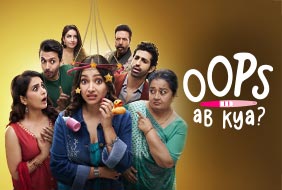
Oops Ab Kya
No. of Episodes
8
Duration
60 mins
Genre
Romance | Comedy | Reunion | Mother-Daughter
A 28-year-old virgin who promised her grandmother to save herself for marriage discovers she's pregnant after a catastrophic medical error accidentally inseminates her with her boss's sperm—the same man she used to have a crush on. As she navigates this absurd nightmare with her devoted policeman boyfriend, multigenerational family trauma and three women's intertwined destinies threaten to tear apart everything she's carefully built. Can love survive when life's cruelest joke destroys the one promise that mattered most?
Oops Ab Kya is a romantic comedy-drama that brings a distinctly Indian flavor to the beloved American series Jane the Virgin. This eight-episode adaptation directed by Debatama Mandal and Prem Mistry for Disney+ Hotstar takes the core premise of a virgin accidentally impregnated through artificial insemination and reimagines it through the lens of Gujarati-Marathi family dynamics, multigenerational women's stories and Bollywood-style melodrama mixed with contemporary sensibilities.
The story centers on Roohi Jaani (Shweta Basu Prasad), a 28-year-old hotel duty manager whose life has been carefully structured around a promise she made to her grandmother Subhadra (Apara Mehta). In her youth, Roohi vowed to preserve her virginity until marriage—a pledge that stems from family trauma and Subhadra's fierce determination to prevent history from repeating itself. This promise, which Roohi refers to metaphorically as her "gullak" (piggy bank), has shaped every romantic decision she's made.
Roohi has been in a committed relationship for three years with Omkar Jadhav (Abhay Mahajan), a sincere policeman who deeply loves her and has agreed to respect her boundaries by waiting until they're officially married before becoming intimate. Their relationship represents the green-flag boyfriend ideal—patient, understanding and genuinely supportive of Roohi's choices without pressuring her to compromise her values. Omkar embodies the stable, reliable partner who checks every box for a successful marriage.
The series carefully establishes three generations of Gujarati women whose lives are interconnected through patterns of rebellion, consequence and redemption. Subhadra Jani is the matriarch whose life was upended when her daughter Paakhi (Sonali Kulkarni) became pregnant as a teenager, bringing social shame to their conservative community. That teenage pregnancy produced Roohi, who was raised by both her single mother Paakhi and grandmother Subhadra. Now reconciled and living as a close-knit family, the three women spend evenings together binge-watching their favorite television soap operas—a meta-textual touch that nods to the melodramatic traditions this series both embraces and gently satirizes.
Everything changes when Roohi visits a gynecologist for a routine checkup. In a catastrophic case of medical malpractice, Dr. Roshni (whose negligence sets the entire plot in motion) accidentally artificially inseminates Roohi with sperm intended for another patient. When Roohi receives the devastating news that she's pregnant despite never having had sexual intercourse, her carefully ordered world implodes. Her "gullak" has broken not through choice but through the most absurd of medical errors.
The situation becomes exponentially more complicated when the identity of the biological father is revealed: Samar Pratap Singh (Aashim Gulati), the wealthy owner of the hotel where Roohi works. Samar represents everything opposite to Omkar—South Bombay privilege, suave sophistication and the kind of effortless charisma that comes with never having worried about money. More devastatingly for Roohi, Samar is also her former crush, a man she once harbored feelings for before committing to her relationship with Omkar.
The series then explores Roohi's emotional turmoil as she navigates this impossible situation. She must decide whether to keep the pregnancy, how to tell Omkar without destroying their relationship, how to face her grandmother whose fears about sexual shame have now been realized through the cruelest irony and how to interact with Samar who is bewildered to discover he's about to become a father through clinical accident rather than romantic connection.
Parallel to Roohi's pregnancy drama runs the revelation of her father's identity. Paakhi's past becomes present when Vanraj (Jaaved Jaaferi), a Bollywood actor, re-enters their lives. The complicated love story between Paakhi and Vanraj—who had their daughter outside of marriage decades ago—offers a through-line connecting the generations. Vanraj's character provides both comic relief and emotional depth, and Jaaved Jaaferi brings his considerable charisma to scenes with Sonali Kulkarni that capture the endearing awkwardness of middle-aged romance rekindling after years apart.
The series embraces a narrator (voiced by Guru Haryani) who guides viewers through the story with commentary, asides and occasional fourth-wall-breaking moments. This device, borrowed directly from Jane the Virgin, works to varying degrees of success. At its best, the narrator provides context and humor that enhances the viewing experience. At its worst, the over-explanation becomes excessive, spelling out emotional beats and comedic moments that would have landed better if allowed to breathe naturally.
Where Oops Ab Kya distinguishes itself from its American inspiration is in its exploration of specifically Indian social dynamics. The shame and scandal surrounding pregnancy outside of marriage carries particular weight in Roohi's community in ways that differ from Jane the Virgin's Miami setting. The series tackles how conservative families weaponize concepts of honor and propriety, how women bear disproportionate consequences for sexual situations whether chosen or accidental and how multigenerational trauma around sexuality and pregnancy gets passed down until someone breaks the cycle.
The show also weaves in commentary about soap operas and television storytelling itself. The family's nightly ritual of watching melodramatic serials becomes both genuine bonding time and an in-joke about the conventions that Oops Ab Kya itself employs. This meta-awareness lends the series some charm, suggesting it understands its own excesses even as it indulges them.
Performances carry much of the series' appeal despite script limitations. Shweta Basu Prasad, who showed remarkable promise even as a child actor in Makdee and has since appeared in Iqbal, The Tashkent Files and Jubilee, finally receives an author-backed role that showcases her range. She navigates Roohi's journey through shock, denial, fear, determination and eventual acceptance with a vulnerability that makes her relatable even when the situations become absurd. Her ability to ground emotional truth in heightened circumstances keeps the series watchable.
Apara Mehta, returning to screens after a long absence, brings warmth and authority to Subhadra. Her performance captures both the grandmother's controlling tendencies born from trauma and her genuine love for her daughter and granddaughter. Sonali Kulkarni as Paakhi provides the middle generation perspective—someone who made choices that scarred her but who has found peace with her unconventional family structure.
Abhay Mahajan deserves particular mention for making Omkar genuinely likable rather than boring. The "good guy" boyfriend role risks becoming one-dimensional, but Mahajan gives Omkar enough personality and genuine emotion that you understand why Roohi chose him and why his reaction to her pregnancy matters so much. The series wisely develops Omkar as a full character rather than simply an obstacle to a more dramatic romance.
Aashim Gulati faces the challenge of playing Samar with his unavoidable "South Bombay" vibe—so ingrained that even period characters he plays somehow feel contemporary. The series leans into this, using Samar's modern sophistication as contrast to Omkar's more traditional earnestness. A character even notes that Samar "looks just like Justin Baldoni," a mistimed reference to the now-controversial actor from the original Jane the Virgin that the series couldn't have anticipated would age poorly.
Critics have noted that Oops Ab Kya suffers from being derivative to a fault. As an adaptation, it hews too closely to Jane the Virgin's structure and plot beats without sufficiently reimagining the material for its new cultural context. The series would have been stronger had it used the premise as a jumping-off point for a genuinely Indian story rather than essentially translating the American version with some surface-level regional specificity.
The production values reflect the Dice Media aesthetic—younger, slightly awkward and decidedly unserious in tone. This works for the show's comedic aspirations but sometimes undercuts the emotional weight of more dramatic scenes. The series can't decide whether it wants to be breezy comedy or affecting family drama, and the tonal inconsistency leaves viewers uncertain how seriously to take any given moment.
Additionally, some sequences veer into cringe territory. The "gullak" metaphor for virginity feels forced and the jokes don't always land with the timing or wit necessary for effective comedy. Certain subplots—like Dr. Roshni's character and the medical malpractice lawsuit subplot—receive insufficient development, existing more as plot devices than fully realized story elements.
The series' conclusion has been described as "convenient"—tying up loose ends in ways that feel more expedient than earned. After seven episodes of complications and emotional turmoil, the resolution arrives too neatly, sacrificing the messy authenticity that makes the best relationship dramas resonate in favor of feel-good closure.
Despite its flaws, Oops Ab Kya offers adequate entertainment for viewers seeking light romantic comedy with family dynamics and who aren't troubled by predictable plotting or borrowed structure. The cast works hard and mostly succeeds in making familiar material feel fresh through committed performances. For those who loved Jane the Virgin and want to see how the premise translates to an Indian context, it provides that experience, even if it never transcends its source material to become something truly distinctive.
The series represents the kind of watchable but uninspired adaptation that satisfies an audience's appetite for content without challenging expectations or offering memorable innovation. It's comfort viewing—pleasant enough in the moment but unlikely to linger in memory once the final credits roll.
 April
April